
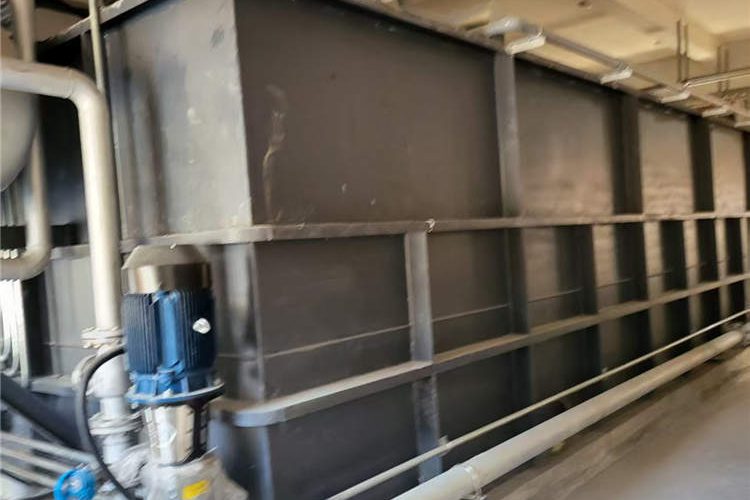
Air flotation machine is a water treatment equipment that uses fine bubbles to achieve solid-liquid separation. It uses the principle of buoyancy to make suspended solids with a density lower than water float to the water surface, thereby achieving the goal of purifying water quality. The following are its core points:
一、 Classification and Structure
1. Main types
Ultra efficient shallow air flotation machine: Based on the “shallow pool theory” and “zero velocity principle”, the residence time is only 3-5 minutes, and the suspended solids removal rate can reach 90% -99.5%.
Dissolved air flotation machine: divided into horizontal flow, upward flow, and comprehensive types, the core equipment includes dissolved air tank, release device, and bubble emitter, with bubble diameter of 20-100 μ m.
Vortex concave air flotation machine: Cutting bubbles by high-speed rotating aeration impeller (2900 revolutions per minute) to form tiny bubbles.
2. Key components
Dissolved gas system (dissolved gas tank, air compressor), scraper, electric control system, and inclined tube group (to enhance separation efficiency).
二、 Working principle
Dissolved gas water generation: The water pump pressurizes water and air into the dissolved gas tank, forming supersaturated dissolved gas water.
Bubble release: Dissolved water enters the air flotation tank through a release device, and the sudden drop in pressure causes bubbles to precipitate and adhere to suspended solids.
Separation process: After the combination of bubbles and flocs, a floating slag layer is formed, heavy particles precipitate, and finally removed by a scraper.
三、 Application Fields
Industrial wastewater: Treatment of oils, colloids, and heavy metal ions from industries such as papermaking, printing and dyeing, and electroplating.
Municipal sewage: Remove suspended solids and organic matter from domestic sewage to improve water quality.
Special scenario: Suitable for low temperature or low turbidity water bodies, compensating for the shortcomings of traditional sedimentation methods.