
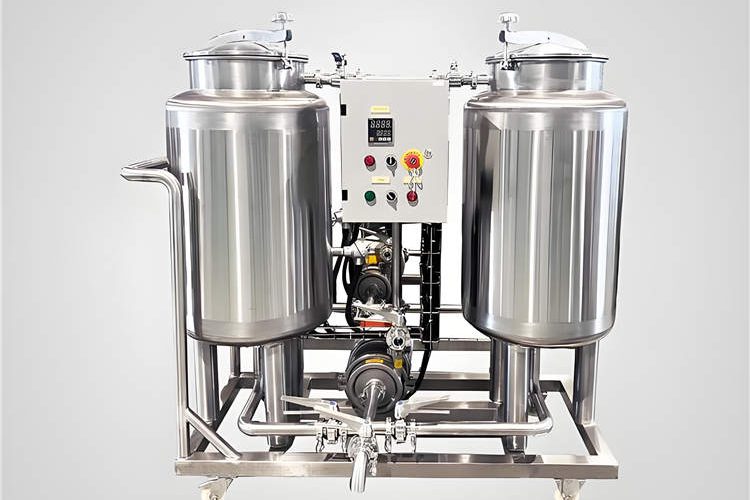
CIP cleaning system (Clean In Place) is an automated cleaning technology widely used in industries such as food, beverage, and pharmaceuticals. It achieves non disassembly cleaning of equipment interior by circulating cleaning solution through closed pipelines.
一、 System composition and working principle
1. Core components
Cleaning solution tank: acid tank, alkali tank, hot water tank (usually made of SUS304/316L stainless steel), used to store different cleaning media.
Circulating pump set: Drive the cleaning solution to create turbulence in the pipeline, enhancing the flushing effect.
Control system: PLC or touch screen control, can preset cleaning program (such as alkali washing → acid washing → disinfection) and monitor temperature, conductivity and other parameters in real time.
2. Cleaning process
Pre rinsing: Remove loose dirt with clean water at room temperature.
Main cleaning: Alkali solution (60-80 ℃) removes fat/protein, acid solution (such as nitric acid) dissolves mineral deposits and scales.
Final washing and disinfection: Use hot water (above 85 ℃) or sterilizers to kill microorganisms.
二、 Technical advantages
1. Efficiency and safety
Fully automated operation reduces manual intervention and shortens cleaning time by more than 50% (e.g. dairy tank cleaning only takes 20-30 minutes).
The closed-loop design avoids secondary pollution and complies with GMP/FDA hygiene standards.
2. Energy conservation and environmental protection
Recycling and reusing cleaning solution reduces water consumption by 30% -50%.
Modular design supports zone cleaning, allowing for simultaneous production and cleaning.
3. Wide adaptability
Suitable for complex equipment such as pipelines, tanks, pumps and valves, with a cleaning coverage rate of up to 99%.
三、 Typical application scenarios
Dairy industry: 360 ° no dead angle cleaning of milk refrigerated tanks with zero microbial detection rate.
Pharmaceutical industry: Clean sterile production line equipment to meet validation requirements.
Beverage/Beer Factory: Regular maintenance of pipelines and fermentation tanks to prevent batch cross contamination.