
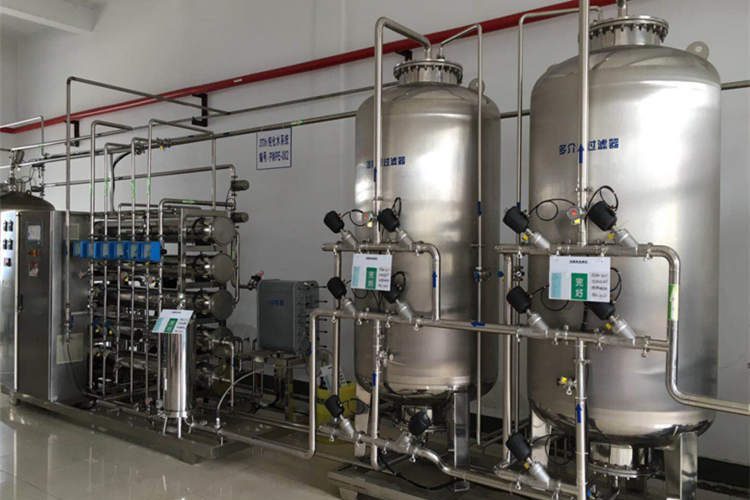
EDI (Electrodeionization) device system is an efficient water treatment equipment that combines electrodialysis and ion exchange technology. It is mainly used to prepare high-purity water and is widely used in industries such as electronics, pharmaceuticals, and chemical engineering. Here is its core introduction:
1. Working principle
Electrodialysis combined with ion exchange: driven by a direct current electric field, ions in water migrate in a directional manner, with cations moving towards the cathode and anions moving towards the anode, in conjunction with selective ion membrane separation of concentrated and fresh water chambers.
Resin self regeneration: Hydrogen ions and hydroxide ions generated by water ionization continuously regenerate the resin without the need for chemical agents, achieving continuous operation.
2. System composition
Core components:
EDI module: including ion exchange resin, cation exchange membrane, and electrode, it is the core unit of desalination.
Power system: Provides a stable DC electric field to drive ion migration.
Pre treatment unit: usually includes a reverse osmosis (RO) device to ensure that the incoming water quality meets the standard.
Auxiliary components: concentrated water chamber, pure water chamber, insulation board and compression board, etc.
3. Technical features
Efficient and stable: The water production resistivity can reach 15-18 M Ω· cm, suitable for 24-hour continuous operation.
Environmental protection and energy conservation: No need for acid-base regeneration, reducing waste liquid emissions.
Automated control: Intelligent monitoring of water quality parameters and automatic adjustment of operating status.
4. Application Fields
Electronics industry: semiconductor cleaning, integrated circuit manufacturing.
Pharmaceutical industry: Purified water preparation, in compliance with GMP standards.
Chemical and laboratory: high-purity reaction medium or analytical water.