
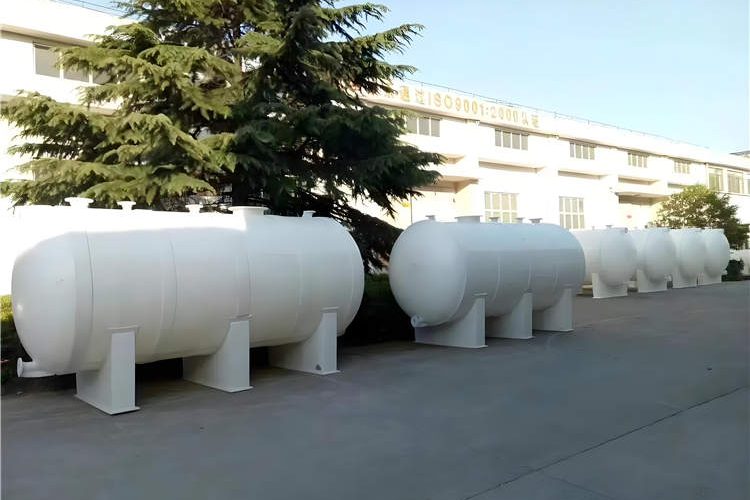
Acid and alkali resistant storage tanks are specialized equipment used in the fields of chemical, pharmaceutical, and environmental protection to store corrosive media. Their selection requires comprehensive consideration of factors such as media characteristics, temperature, pressure, and economy.
一、 Classified by Material
1. Steel lined plastic storage tank
Structure: The carbon steel/stainless steel shell is lined with anti-corrosion coatings such as polyethylene (PE) and polytetrafluoroethylene (PTFE), which combine metal strength and plastic corrosion resistance.
Advantages: Strong pressure resistance (up to 0.1MPa), suitable for strong acid and alkali (such as concentrated sulfuric acid, liquid alkali) and high temperature environments.
Application: Storage of highly corrosive liquids in the chemical and lithium battery industries.
2. Fiberglass reinforced plastic (FRP) storage tank
Structure: resin matrix and glass fiber composite, designed in three layers: anti-corrosion layer, anti-seepage layer, and structural layer.
Advantages: Resistant to various acids, alkalis, and salts, with a lifespan three times that of stainless steel (such as in a 40% sulfuric acid environment), and low maintenance costs.
Limitations: Not applicable to hydrofluoric acid (fluorine-containing resin required) and organic solvents (graphite powder required).
3. PP/PPH storage tank
PP storage tank: Welding of polypropylene sheet, suitable for conventional acid-base media, customizable with irregular structures.
PPH storage tank: mechanically wrapped with homopolymer polypropylene, no welds, resistant to concentrated sulfuric acid and hydrofluoric acid, suitable for high temperature and high pressure environments up to 80 ℃.
4. Stainless steel storage tank
Material selection: 304 stainless steel is used for weak acid and weak alkali, while 316L is suitable for strong corrosive environments such as hydrochloric acid and high-temperature alkaline solutions.
Limitations: High concentration alkaline solution may cause uniform corrosion, requiring regular repair or lining with anti-corrosion layer.
二、 Key factors for selection
Medium characteristics: Strong oxidizing acids (such as nitric acid) require phenolic resin and fiberglass reinforced plastic. For high concentrations of alkali (>30%), it is recommended to use bismaleimide resin.
Temperature and pressure: For fiberglass above 80 ℃, a furan resin layer needs to be added, and the pressure resistance of PPH storage tanks should be ≤ 0.1MPa.
Economy: The cost of steel lined plastic storage tanks is lower than that of stainless steel, and the maintenance cost of fiberglass is lower.